In stock
The Gumpii Apothecary
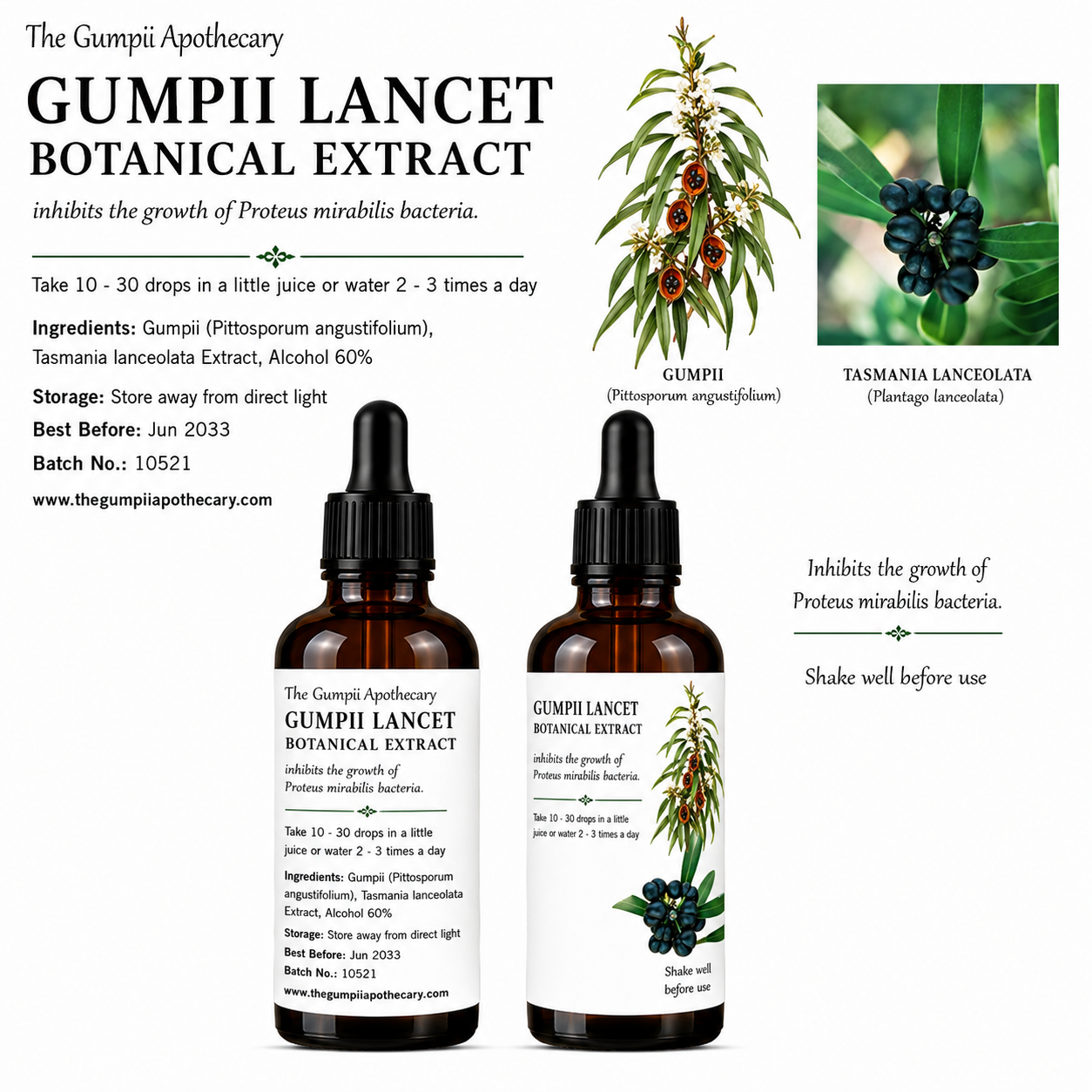
Gumpii Lancet Botanical Extract
Gumpii Lancet Botanical Extract
Couldn't load pickup availability
Wild Harvested Australian Gumpii/Lancet Extract
A proprietary wildcrafted Australian botanical formula combining two of Australia's most researched native plants — Tasmania lanceolata (Tasmanian Pepperberry fruit) and Gumpii (Pittosporum angustifolium). Both botanicals have deep roots in traditional Aboriginal medicine and have been independently validated in peer-reviewed scientific research for their biological activity.
This is The Gumpii Apothecary's proprietary formula — wild crafted, small batch, Australian made.
Why These Two Botanicals
In a landmark study published in Pharmacognosy Magazine (Cock et al., 2015), 106 extracts from 40 Australian plant species were tested for their ability to inhibit the growth of Proteus mirabilis — a bacterium linked to urinary tract infections and immune system disorders including inflammatory joint conditions.
Of all 40 plant species tested:
- Tasmania lanceolata fruit was the single most effective inhibitor of P. mirabilis growth, with MIC values of just 11 µg/ml (methanolic) and 126 µg/ml (aqueous)
- Pittosporum angustifolium (Gumpii) was also identified among the most effective inhibitors of P. mirabilis growth
- Both extracts were confirmed to be non-toxic or of low toxicity in the Artemia nauplii bioassay
The Gumpii Apothecary has combined both botanicals into a single proprietary wildcrafted formula — bringing together the two most potent anti-Proteus Australian plants identified in this research.
About Tasmania lanceolata
Tasmania lanceolata has a long history of traditional use by Aboriginal Australians and was adopted by early European settlers as a culinary spice and medicinal plant. Tasmania lanceolata had a high anti-diabetic potential. In silico molecular docking predicted that flavonoids have a significant role in the inhibition of α-glucosidase. https://www.sciencedirect.com/science/article/pii/S0753332225006973#bbib71
The berries are characterised by a distinctive peppery heat due to naturally occurring polygodial — a sesquiterpene dialdehyde unique to the Winteraceae family. Active compounds identified in T. lanceolata fruit include:
- Polygodial — sesquiterpene dialdehyde with potent biological activity
- Piceid — a resveratrol glycoside with antioxidant properties
- Combretastatin stilbenes A-1 and A-4 — bioactive stilbene compounds
- Antioxidant phenolic compounds
About Gumpii (Pittosporum angustifolium)
Gumpii is a native Australian tree with deep roots in traditional Aboriginal bush medicine, used for generations as a broad-support botanical across multiple body systems. It contains a complex profile of saponins, flavonoids, tannins, alkaloids, and phenolic compounds. For a full phytochemical profile, see the Australian Gumpii Extract product page.
Proteus mirabilis — Why It Matters
Proteus mirabilis is a gram-negative bacterium commonly associated with urinary tract infections. Research has also identified it as a potential microbial trigger in the onset of certain immune system disorders, including inflammatory joint conditions. Its ability to colonise and persist in the body makes it a significant target in both infection management and immune system support.
Both botanicals in this formula have demonstrated inhibitory activity against P. mirabilis in laboratory studies — making this a uniquely targeted Australian wildcrafted formula.
Traditional Use
Both Tasmania lanceolata and Pittosporum angustifolium have histories of traditional use in Australian Aboriginal medicine for inflammatory conditions, infections, and general immune system support. Tasmania lanceolata was also one of the first Australian native plants adopted into European colonial medicine.
Key Areas of Traditional & Researched Application
- Immune System Support — broad-spectrum immune modulation via two complementary botanicals
- Anti-Proteus Activity — both botanicals confirmed as potent inhibitors of P. mirabilis in peer-reviewed research
- Urinary Tract Health — traditionally used to support urinary tract comfort and function
- Inflammatory Joint Conditions — traditionally used to support joint comfort and mobility
- Antimicrobial Support — broad-spectrum activity against bacteria and fungi
- Antioxidant — rich in phenolic compounds, stilbenes, and resveratrol glycosides
- Immune System Disorders — traditionally used to support healthy immune system function
Naturally Occurring Compounds
Tasmannia lanceolata is one of Australia's most phytochemically rich native plants, containing over 80 identified non-anthocyanin polyphenols and flavonoids. Key bioactive compounds include:
- Polygodial — sesquiterpene dialdehyde, unique to the Winteraceae family
- Chlorogenic acid, p-coumaric acid, caffeic acid, t-ferulic acid — phenolic acids with antioxidant activity also found in green coffee and turmeric
- Piceid — a resveratrol glycoside with antioxidant properties
- Combretastatin stilbenes A-1 and A-4 — bioactive stilbene compounds
- Flavonoids — with antioxidant and potential anti-inflammatory properties
Laboratory Research Context
In preliminary laboratory studies, Tasmannia lanceolata extracts demonstrated notable cytotoxic activity against two standard cancer research cell lines:
- HeLa cells — a human cervical cancer cell line, one of the most widely used in biological and medical research worldwide. Named after Henrietta Lacks, HeLa cells have been used in cancer research for over 70 years.
- HT29 cells — a human colorectal adenocarcinoma cell line, commonly used in laboratory studies investigating compounds with potential activity against colon cancer cells.
Tasmannia lanceolata was among the most potent of all Australian native plant extracts tested — cells treated with the extracts showed no viable cells compared to the positive control group.
This is early-stage laboratory research and does not constitute clinical evidence of efficacy in humans. These results are presented for informational and educational purposes only. Not medical advice. Not intended to diagnose, treat, or cure any condition.
Ingredients
Wildcrafted Tasmania lanceolata fruit, Wildcrafted Gumpii (Pittosporum angustifolium), Purified Water, Alcohol (ethanol), proprietary blend.
Our Extraction Method
The Gumpii Apothecary uses the Swiss method of ethanol extraction for all alcohol-based botanical extracts. We typically use a 60% ethanol base for robust botanicals, and 45% ethanol for more fragile flora. Product labels and images are a guide only — alcohol concentration may vary by botanical and batch.
Dosage Guide
20–30 drops in a little juice or water, 2–3 times daily, or as directed by your healthcare practitioner.
Side Effects: All active extracts in this formula were confirmed non-toxic or of low toxicity in bioassay testing. Always consult your healthcare practitioner before use.
Precautions
Consult your healthcare practitioner before use. Not recommended during pregnancy or breastfeeding without practitioner guidance. Keep out of reach of children. Store away from direct light. Shake well before use.
Stack This With
- Australian Gumpii Extract — standalone Gumpii for foundational broad-spectrum support
- Intestinal Cleanse Botanical Extract — also contains Lancet as part of its formula
- Quercetin — complementary antioxidant flavonoid
Research References
- Cock, I. E., Winnett, V., Sirdaarta, J., & Matthews, B. (2015). The potential of selected Australian medicinal plants with anti-Proteus activity for the treatment and prevention of rheumatoid arthritis. Pharmacognosy Magazine. ResearchGate
- Griffith University Research Repository — Tasmannia lanceolata study. Griffith University Repository
- Griffith University Research Repository — Tasmannia lanceolata study. Griffith University Repository
- Griffith University Research Repository — Tasmannia lanceolata study. Griffith University Repository
- Tasmannia lanceolata extracts: anti-Proteus activity and potential for the treatment and prevention of rheumatoid arthritis — ResearchGate
- Winnett, V., Boyer, H., Sirdaarta, J., & Cock, I. E. (2014). The potential of Tasmannia lanceolata as a natural preservative and medicinal agent: antimicrobial activity and toxicity. Pharmacognosy Communications, 4(1). ResearchGate
- Cock IE et al. Cytotoxic activity of Australian native plant extracts including Tasmannia lanceolata against HeLa and HT29 cell lines. Pharmacognosy Magazine / Journal of Pharmacognosy and Phytochemistry. ScienceDirect
Related Wellness Guides
- Immune, Respiratory & Infections Support
- Wellness Hub — explore all herbal guides
Content provided for informational purposes only. Not medical advice. Not intended to diagnose, treat, or cure any condition. Consult your healthcare practitioner.