In stock
The Gumpii Apothecary
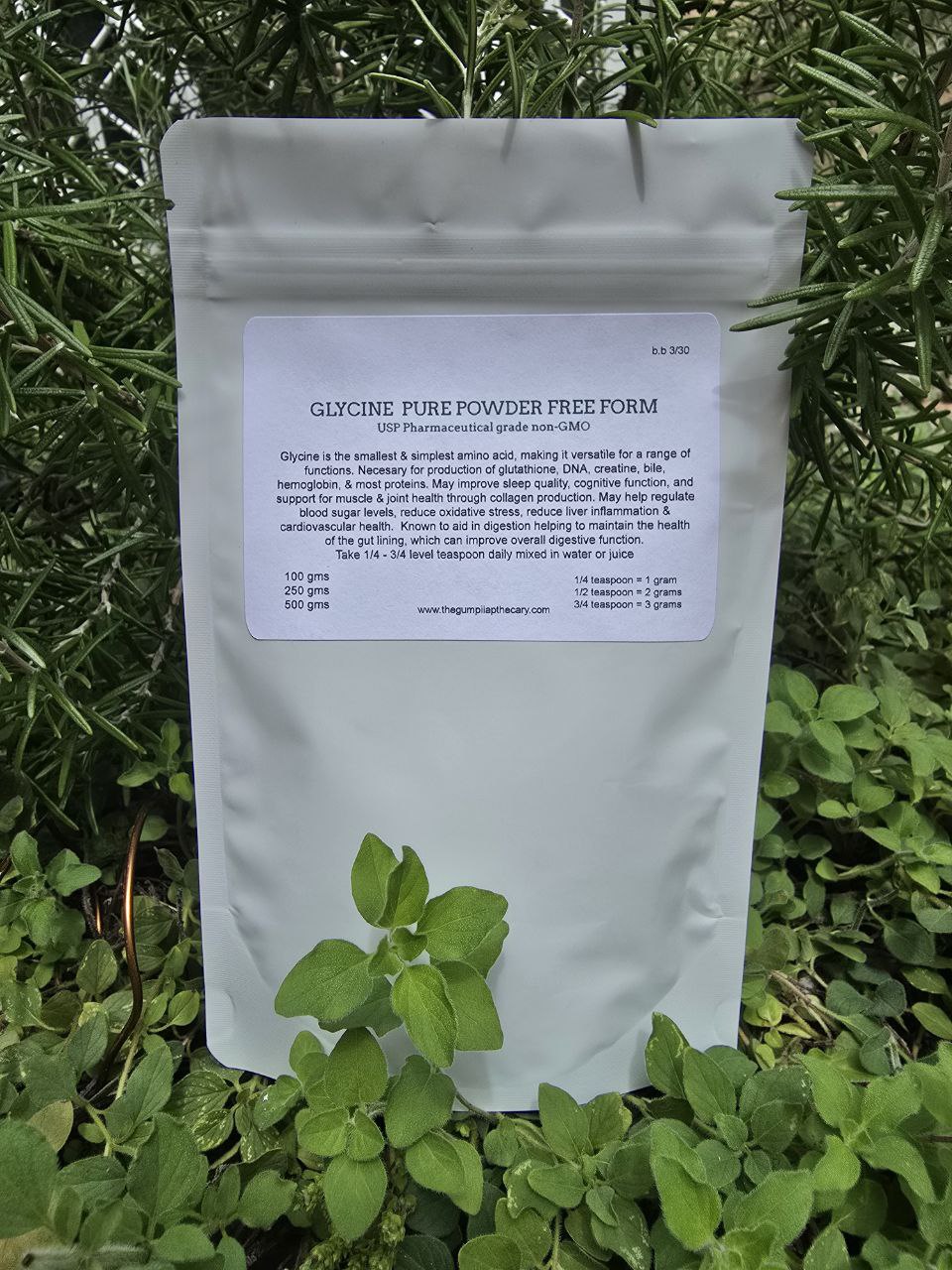
Glycine Powder Free Form
Glycine Powder Free Form
Couldn't load pickup availability
Glycine Powder – Free Form Amino Acid
Supports deeper sleep, relaxation, and nervous system recovery.
Glycine is the smallest and simplest of the amino acids, and one of the most abundant in the human body. It is a conditionally essential amino acid — meaning the body produces it, but dietary intake is often insufficient to meet the body's full requirements. Glycine plays a foundational role in numerous biological processes and is a popular supplement in functional nutrition and integrative health practice.
This free-form powder offers flexible dosing and is ideal for mixing into water before bed or adding to other beverages.
Also Available in Capsules
Glycine Capsules — convenient, precise dosing, easy to take on the go.
What is Glycine
Glycine is involved in the production of:
- Glutathione — the body's primary antioxidant
- Collagen — the most abundant protein in the body
- Creatine — for cellular energy
- Bile salts — for fat digestion
- Haemoglobin — for oxygen transport
- DNA and RNA bases
It also functions as an inhibitory neurotransmitter in the central nervous system, playing a role in neural signalling and the regulation of excitatory activity in the brain and spinal cord.
Vitamin C (Sodium Ascorbate) & Amino Acid Uptake
Vitamin C (sodium ascorbate) plays an important role in amino acid uptake and utilisation — including glycine. It is also an essential cofactor for collagen synthesis, working directly alongside glycine to build and maintain connective tissue. Unlike most mammals, humans have lost the ability to synthesise Vitamin C internally, making regular dietary or supplemental intake critical. Pairing glycine with sodium ascorbate is one of the most foundational combinations in nutritional practice.
The Methionine & Glycine Balance
This is one of the most overlooked aspects of modern nutrition — and one of the most important.
Methionine and glycine have an inverse relationship in the body. As methionine intake increases, the body's need for glycine rises proportionally — roughly 0.5 to 1 gram of glycine for every gram of methionine consumed.
The problem? The modern Western diet is high in methionine-rich foods — meat, fish, eggs, and dairy — while being very low in the glycine-rich foods our ancestors ate regularly: bone broth, gelatin, and connective tissue. The result is a widespread, silent glycine deficit that most people never connect to their symptoms.
Signs of this imbalance can include:
- Poor sleep and difficulty winding down
- Inflammation and joint discomfort
- Sluggish detoxification
- Skin and connective tissue issues
- Low energy and poor recovery
Supplementing with glycine is a simple, well-tolerated way to restore this balance — particularly for those eating a high-protein diet. It's not about eating less protein. It's about making sure your glycine keeps pace. The powder format makes it easy to dial in your exact dose.
Traditional & Nutritional Use
Sleep & Nervous System
Glycine is widely used in nutritional practice to support sleep quality and nervous system calm. As an inhibitory neurotransmitter, it plays a role in supporting the parasympathetic (rest-and-recover) state. It is commonly taken before bed dissolved in water — making the powder format particularly convenient.
Recovery & Cellular Protection
Glycine is a precursor to glutathione — the body's primary endogenous antioxidant. It is also essential for collagen synthesis, making it relevant for connective tissue, skin, and joint support.
Vitamin C (sodium ascorbate) is a critical cofactor in this process — it is required for collagen synthesis and has been shown to enhance glycine uptake. Humans, unlike most mammals, produce very little Vitamin C endogenously, making supplemental intake essential for most people. Pairing glycine with sodium ascorbate is a foundational combination for collagen production, connective tissue repair, and antioxidant support.
Liver & Metabolic Support
Glycine is involved in bile acid conjugation and liver detoxification pathways. It is commonly used in nutritional practice to support liver function and healthy metabolic processes.
Gut & Digestive Health
Glycine supports the integrity of the gut wall and mucous membranes lining the digestive tract. It plays a role in maintaining the gut barrier and may support digestive comfort. Its anti-inflammatory properties help protect mucosal tissue, while its role in regulating stomach acidity supports comfortable, efficient digestion.
Bladder & Urinary Health
Glycine acts as an inhibitory neurotransmitter in the spinal cord, directly regulating the micturition (urination) reflex. Research suggests that glycine levels may play a role in bladder and urinary wellness. A peer-reviewed clinical study (Sugaya et al., 2021) found that oral glycine supplementation at 3g twice daily for 8 weeks was associated with improvements in nocturia, urinary urgency, and bladder comfort — with no adverse events recorded. Glycine also supports the mucous membrane lining of the bladder, with anti-inflammatory properties that may support bladder comfort. It has a long-established clinical role in urology, where it is used as an irrigating solution to protect tissue integrity during procedures.
View clinical research: Glycine & Urine Storage Disorders (PubMed)
What the Experts Say
Ray Peat, PhD
"Glycine protects against fibrosis, inflammation, free radical damage, and mitochondrial dysfunction."
Dr. Ray Peat wrote extensively about glycine as one of the most important and underappreciated amino acids, particularly in the context of balancing methionine intake and supporting mitochondrial function.
Paul Saladino, MD
Dr. Paul Saladino highlights the dietary imbalance created by eating muscle meat without the connective tissue that traditionally accompanied it. He argues that rather than restricting methionine — as some plant-based advocates suggest — the smarter approach is to ensure adequate glycine intake.
"Glycine supplementation extends lifespan of male and female mice."
He notes that for those eating a muscle-meat-heavy diet without connective tissue cuts or bone broth, glycine supplementation is a practical and effective solution.
Joel Brind, PhD
Dr. Joel Brind graduated from Yale College (1971) and earned his doctorate from New York University (1981) in Basic Medical Sciences, with specialisation in biochemistry, physiology, and immunology. From 1986 until his retirement in 2020, he was a professor of human biology and endocrinology at Baruch College, City University of New York. Since 2007, Dr. Brind has studied amino acid metabolism in the context of nutrition and aging. In 2010 he founded Natural Food Science, LLC, and in 2024 published The Glycine Miracle: The Science of Living Long and Free From Inflammation.
"Glycine is not only an essential nutrient — it is the body's primary regulator of inflammation."
Dr. Brind's research found that due to the typical Western diet, virtually all people suffer from insufficient glycine levels. In a glycine-deficient state, the body may develop inappropriate or excessive inflammatory responses — leading to chronic inflammation and accelerated aging.
How to Use
Take 3–10g daily, dissolved in water or added to a beverage. For sleep support, take 3g approximately 30–60 minutes before bed. For general wellness and metabolic support, larger doses can be split across the day. Start with a lower dose and increase gradually.
Precautions
Generally very well tolerated. Consult your healthcare practitioner before use if you are pregnant or nursing, taking antipsychotic medication (particularly clozapine), or have kidney concerns. Keep out of reach of children.
Stack This With
- Sodium Ascorbate (Vitamin C) — essential cofactor for collagen synthesis; enhances glycine uptake
- Magnesium Glycinate — nervous system calm, deeper sleep
- NAC (N-Acetyl Cysteine) — pairs with glycine to support glutathione production
Related Wellness Guides
- Wellness Hub — explore all herbal and nutritional guides
Content provided for informational purposes only. Not medical advice. Not intended to diagnose, treat, or cure any condition. Consult your healthcare practitioner.