In stock
The Gumpii Apothecary
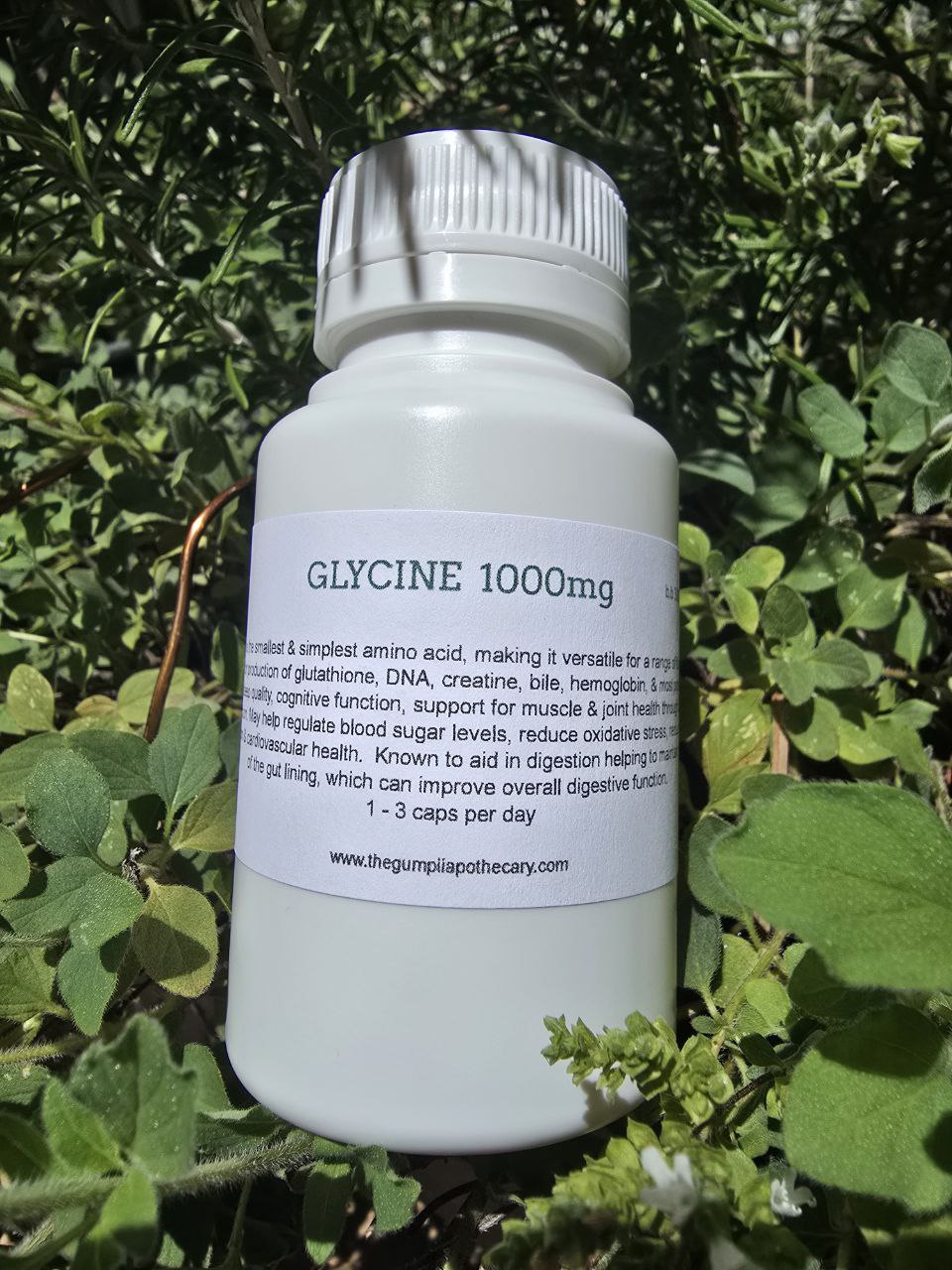
Glycine Capsules
Glycine Capsules
Couldn't load pickup availability
Glycine – Sleep & Nervous System Support
Supports deeper sleep, relaxation, and nervous system recovery.
Choose Your Format
- Capsules – convenient, precise dosing, easy to take on the go
- Powder – flexible dosing, ideal before bed in water
Most people start with capsules for simplicity.
What is Glycine
Glycine is the smallest and simplest of the amino acids, and one of the most abundant in the human body. It is a conditionally essential amino acid — meaning the body produces it, but dietary intake is often insufficient to meet the body’s full requirements. Glycine plays a foundational role in numerous biological processes and is a popular supplement in functional nutrition and integrative health practice.
Glycine is involved in the production of:
- Glutathione — the body’s primary antioxidant
- Collagen — the most abundant protein in the body
- Creatine — for cellular energy
- Bile salts — for fat digestion
- Haemoglobin — for oxygen transport
- DNA and RNA bases
It also functions as an inhibitory neurotransmitter in the central nervous system, playing a role in neural signalling and the regulation of excitatory activity in the brain and spinal cord.
Vitamin C (Sodium Ascorbate) & Amino Acid Uptake
Vitamin C (sodium ascorbate) plays an important role in amino acid uptake and utilisation — including glycine. It is also an essential cofactor for collagen synthesis, working directly alongside glycine to build and maintain connective tissue. Unlike most mammals, humans have lost the ability to synthesise Vitamin C internally, making regular dietary or supplemental intake critical. Pairing glycine with sodium ascorbate is one of the most foundational combinations in nutritional practice.
The Methionine & Glycine Balance
This is one of the most overlooked aspects of modern nutrition — and one of the most important.
Methionine and glycine have an inverse relationship in the body. As methionine intake increases, the body’s need for glycine rises proportionally — roughly 0.5 to 1 gram of glycine for every gram of methionine consumed.
The problem? The modern Western diet is high in methionine-rich foods — meat, fish, eggs, and dairy — while being very low in the glycine-rich foods our ancestors ate regularly: bone broth, gelatin, and connective tissue. The result is a widespread, silent glycine deficit that most people never connect to their symptoms.
Signs of this imbalance can include:
- Poor sleep and difficulty winding down
- Inflammation and joint discomfort
- Sluggish detoxification
- Skin and connective tissue issues
- Low energy and poor recovery
Supplementing with glycine is a simple, well-tolerated way to restore this balance — particularly for those eating a high-protein diet. It’s not about eating less protein. It’s about making sure your glycine keeps pace.
Traditional & Nutritional Use
Sleep & Nervous System
Glycine is widely used in nutritional practice to support sleep quality and nervous system calm. As an inhibitory neurotransmitter, it plays a role in supporting the parasympathetic (rest-and-recover) state. Capsules are ideal for precise dosing before bed.
Recovery & Cellular Protection
Glycine is a precursor to glutathione — the body’s primary endogenous antioxidant. It is also essential for collagen synthesis, making it relevant for connective tissue, skin, and joint support.
Vitamin C (sodium ascorbate) is a critical cofactor in this process — it is required for collagen synthesis and has been shown to enhance glycine uptake. Humans, unlike most mammals, produce very little Vitamin C endogenously, making supplemental intake essential for most people. Pairing glycine with sodium ascorbate is a foundational combination for collagen production, connective tissue repair, and antioxidant support.
Liver & Metabolic Support
Glycine is involved in bile acid conjugation and liver detoxification pathways. It is commonly used in nutritional practice to support liver function and healthy metabolic processes.
Gut & Digestive Health
Glycine supports the integrity of the gut wall and mucous membranes lining the digestive tract. It plays a role in maintaining the gut barrier, reducing the risk of intestinal permeability (“leaky gut”), and may aid in the healing of digestive ulcers. Its anti-inflammatory properties help protect mucosal tissue from damage, while its role in regulating stomach acidity supports comfortable, efficient digestion.
Bladder & Urinary Health
Glycine acts as an inhibitory neurotransmitter in the spinal cord, playing a role in regulating the urination reflex. Research suggests that glycine levels may be associated with bladder and urinary comfort — including nocturia, urgency, and bladder irritation. A peer-reviewed clinical study (Sugaya et al., 2021) found that oral glycine supplementation at 3g twice daily for 8 weeks was associated with improvements in nocturia, urinary urgency, urge incontinence, bladder comfort, and blood pressure — with no adverse events recorded. Glycine also supports the mucous membrane lining of the bladder, with anti-inflammatory properties that may support bladder comfort. It has a long-established clinical role in urology, where it is used as an irrigating solution to protect tissue integrity during procedures.
View clinical research: Glycine & Urine Storage Disorders (PubMed)
What the Experts Say
Ray Peat, PhD
“Glycine protects against fibrosis, inflammation, free radical damage, and mitochondrial dysfunction.”
Dr. Ray Peat wrote extensively about glycine as one of the most important and underappreciated amino acids, particularly in the context of balancing methionine intake and supporting mitochondrial function.
Paul Saladino, MD
Dr. Paul Saladino highlights the dietary imbalance created by eating muscle meat without the connective tissue that traditionally accompanied it. He argues that rather than restricting methionine — as some plant-based advocates suggest — the smarter approach is to ensure adequate glycine intake.
“Glycine supplementation extends lifespan of male and female mice.”
He notes that for those eating a muscle-meat-heavy diet without connective tissue cuts or bone broth, glycine supplementation is a practical and effective solution. Restricting methionine, by contrast, leads to malnourishment — not longevity.
Joel Brind, PhD
Dr. Joel Brind graduated from Yale College (1971) and earned his doctorate from New York University (1981) in Basic Medical Sciences, with specialisation in biochemistry, physiology, and immunology. From 1986 until his retirement in 2020, he was a professor of human biology and endocrinology at Baruch College, City University of New York. Since 2007, Dr. Brind has studied amino acid metabolism in the context of nutrition and aging. In 2010 he founded Natural Food Science, LLC, and in 2024 published The Glycine Miracle: The Science of Living Long and Free From Inflammation.
“Glycine is not only an essential nutrient — it is the body’s primary regulator of inflammation.”
Dr. Brind’s research found that due to the typical Western diet, virtually all people suffer from insufficient glycine levels. In a glycine-deficient state, the body develops inappropriate or excessive inflammation in response to physical or chemical stresses, infections, or injuries — leading to chronic inflammation and disorders such as arthritis, diabetes, cardiovascular disease, and cancer. His research demonstrates that adequate daily glycine supplementation can mitigate, and often eliminate, this inappropriate inflammation — resulting in a longer and healthier life.
These perspectives are presented for informational context.
Don Tyson / Montiff Inc.
Montiff Inc., founded by Don Tyson — a recognised authority in advanced amino acid therapeutics — has documented glycine’s broad physiological roles across decades of clinical nutritional research. Key findings include glycine’s role in gluconeogenesis and blood sugar regulation; its function as an inhibitory neurotransmitter alongside GABA and Taurine; its involvement in bile acid metabolism and gastrointestinal function; and its use in supporting muscle tissue integrity, including research interest in degenerative muscle conditions. Montiff’s research also highlights glycine’s role in supporting healthy nervous system function and its study in the context of epilepsy management.
In the area of anticarcinogenic research, a preliminary animal study published in 1999 found that glycine prevented the formation of small tumours by 23% and inhibited the development of larger tumours by 80% in hepatic cancer models. A separate study in animals with melanomas found that a glycine-supplemented diet resulted in 50–70% less tumour size compared to controls. Glycine is proposed to inhibit angiogenesis — the formation of new blood vessels that feed tumour growth. (Research context only. Not a therapeutic claim.)
Growth hormone studies have shown significant increases in growth hormone levels in those supplementing with 4–12 grams of glycine daily — relevant for healthy ageing, recovery, and metabolic support.
Reference: Montiff Inc. Pure Glycine — Nutritional & Functional Reference. Don Tyson’s Advanced Nutraceuticals.
Key Benefits
- Supports relaxation and nervous system calm
- Helps improve sleep quality
- Helps reduce stress and mental fatigue
- Supports recovery and cellular protection
- Supports gut wall integrity and mucosal health
- Supports bladder comfort and urinary wellness — backed by peer-reviewed research
How Glycine Works
Glycine supports the body through several key mechanisms:
- Acts as an inhibitory neurotransmitter to calm the brain and spinal cord
- Reduces neural over-activity and mental tension
- Supports parasympathetic (rest-and-recover) function
- Helps regulate nighttime cortisol patterns
- Supports healthy bladder and urinary function via its role as an inhibitory neurotransmitter
Who It’s For
Glycine may be beneficial if you experience:
- Difficulty falling asleep
- Light or disrupted sleep
- Mental over-activity at night
- Ongoing stress or fatigue
- Poor recovery
- Bladder urgency, nocturia, or bladder discomfort
- Digestive discomfort or gut barrier concerns
It is also particularly relevant for anyone eating a high-protein diet who wants to ensure their methionine and glycine remain in balance.
Dosage Guide
Take as directed by your healthcare practitioner. For adults only.
Stack This With
- Glycine Powder — same formula in powder format for flexible dosing
- Sodium Ascorbate (Vitamin C) — enhances glycine uptake; essential cofactor for collagen synthesis
- Magnesium Glycinate — nervous system and recovery support
- Oat Straw Extract — traditional nervine support
- Gumpii Extract — foundational botanical base
- Sleep Support Collection — explore all sleep and nervous system products
- Liver, Kidney & Detox Support Collection — explore detox and metabolic support
- Pain, Inflammation & Joint Health Collection — collagen, joints, and recovery
- Digestive & Gut Health Collection — gut wall, mucosal, and digestive support
Related Wellness Guides
- Natural Sleep Support
- Glycine — What Is It & Why It Matters
- Wellness Hub — explore all herbal guides
Research & References
- Brind JL (2024). The Glycine Miracle: The Science of Living Long and Free From Inflammation. Natural Food Science LLC. Available on Amazon.
- Montiff Inc. Pure Glycine — Nutritional & Functional Reference. Don Tyson’s Advanced Nutraceuticals.
- Sugaya et al. (2021) — Effects of Additional Glycine in Outpatients Being Treated for Urine Storage Disorders — PubMed
- Sugaya et al. (2021) — ResearchGate Full Text
- SNH Healthcare — The Purpose of Glycine in Urology
Content provided for informational purposes only. Not medical advice. Not intended to diagnose, treat, or cure any condition. Consult your healthcare practitioner.