In stock
The Gumpii Apothecary
Methylene Blue
Methylene Blue
Couldn't load pickup availability
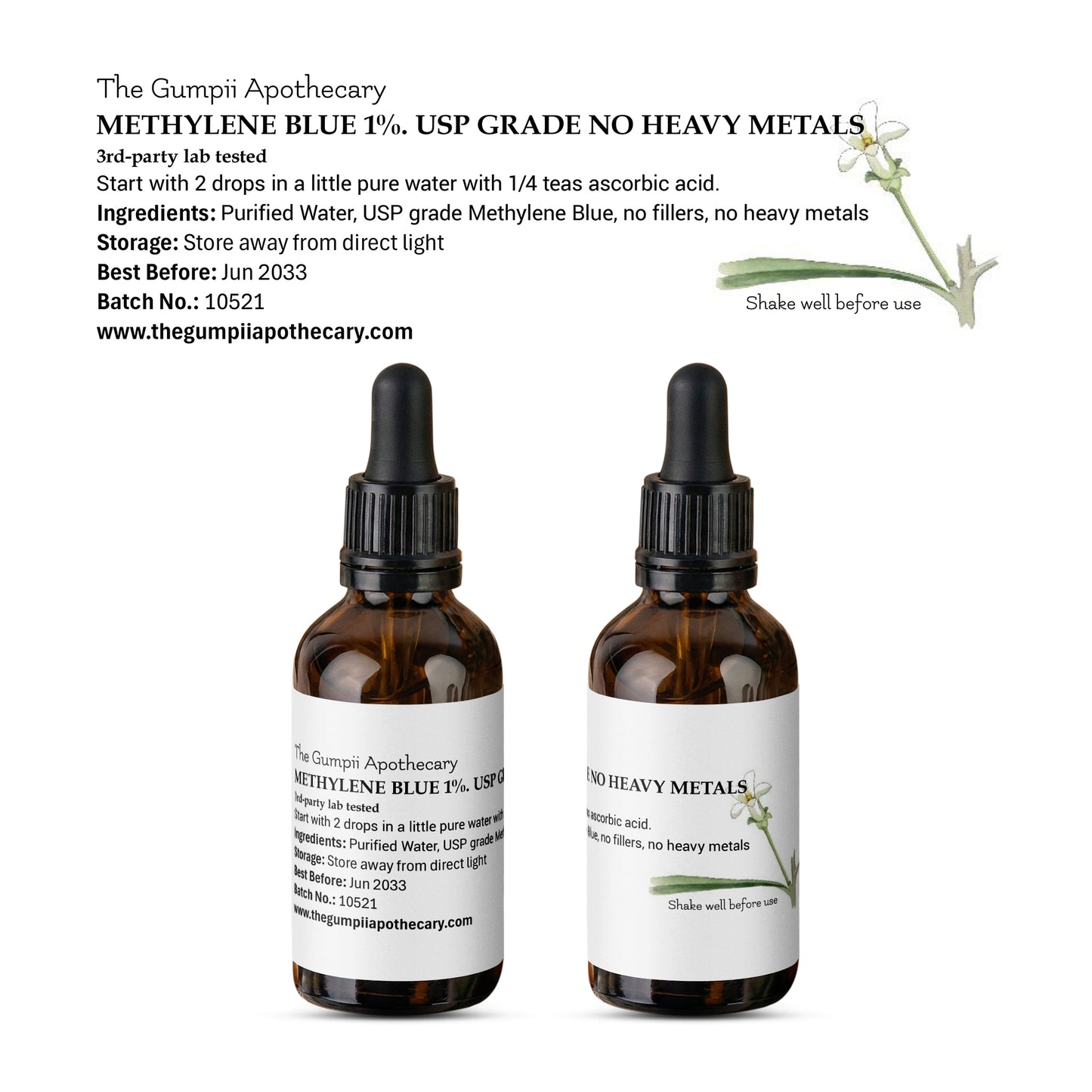
Methylene Blue 1% in Distilled Water
Methylene Blue is a synthetic compound with over 130 years of documented use in science and medicine. First synthesised in 1876, it was the first pharmaceutical drug prescribed in the United States and remains one of the most studied synthetic molecules in biomedical research. It is on the World Health Organisation's List of Essential Medicines.
This preparation is 1% Methylene Blue in distilled water — USP pharmaceutical grade, with purity independently tested by Centricor Analytical Labs. The liquid format makes it easy to measure precise micro-doses.
The Gumpii Apothecary Quality Standard
Not all Methylene Blue is equal. Purity matters enormously with this compound — contaminated or low-grade preparations can introduce heavy metals and toxins that undermine the very benefits you're seeking. We stock only pharmaceutical-grade Methylene Blue, and we have our purity independently tested by Centricor Analytical Labs. Test results are available on request.
- USP pharmaceutical grade — meets United States Pharmacopeia standards
- Our purity tested by Centricor Analytical Labs — independent verification; results available on request
- No heavy metals or toxins — independently confirmed absent
- Distilled water base — no additives, fillers, or preservatives
If you are sourcing Methylene Blue elsewhere, always verify the grade and request third-party test results. Pharmaceutical grade with independent heavy metal testing is the minimum standard worth considering.
About Methylene Blue
Methylene Blue is a redox-active compound — meaning it can cycle between oxidised and reduced states, acting as an electron carrier. This property underpins its wide range of biological activity and has made it the subject of extensive scientific research over many decades. It has been used historically as a biological stain, an antimalarial agent, in the treatment of methemoglobinemia, and in carbon monoxide poisoning — where it helps displace carbon monoxide from red blood cells.
In recent years, growing scientific and biohacking community interest has focused on Methylene Blue at very low (sub-therapeutic) doses, particularly in the context of mitochondrial biology, redox chemistry, and cognitive health research.
Areas of Scientific Research Interest
Mitochondrial Function & Energy Production
One of the most researched areas of Methylene Blue is its interaction with the mitochondrial electron transport chain. MB binds to cytochrome c oxidase (Complex IV), and research has explored its ability to support mitochondrial efficiency by acting as an alternative electron carrier. This has generated significant scientific interest in the context of mitochondrial biology, cellular energy research, and metabolic health.
Cognitive Health Research
Dr. Francisco Gonzalez-Lima, a neuroscientist at the University of Texas at Austin, has published extensively on Methylene Blue and brain function. His research has explored MB's potential associations with cerebral blood flow, memory consolidation, and mitochondrial respiration in neurons.
"Methylene blue is the oldest synthetic drug used in medicine and has a remarkable history of diverse therapeutic applications." — Gonzalez-Lima & Barksdale, 2014
Research interest in MB and cognitive health has explored several complementary mechanisms:
- Mitochondrial efficiency — enhanced oxygen uptake via cytochrome c oxidase and its potential association with brain energy metabolism
- BDNF associations — MB has been associated in research with brain-derived neurotrophic factor (BDNF), which is studied for its role in neuronal health and synaptic function
- MAO inhibition — as a mild monoamine oxidase inhibitor, MB may allow neurotransmitters like serotonin to remain active longer in the synapse; an area of ongoing research interest
- Cerebral blood flow — research has explored MB's potential associations with healthy circulation to the brain
Methylene Blue is notable for its excellent oral bioavailability. A commonly discussed low-dose protocol in the research and biohacking community is around 10mg taken in the morning, on an empty stomach or with food.
Redox Activity & Antioxidant Research
MB's redox-cycling ability allows it to act as both an antioxidant and a pro-oxidant depending on context and dose. At low doses, research has explored its associations with reduced oxidative stress markers and support for the body's endogenous antioxidant systems, including glutathione.
Combining with Sodium Ascorbate or Glycine — Blue Mouth No More!
Two simple additions to your MB routine can eliminate the characteristic blue mouth and tongue discolouration:
Option 1 — Sodium Ascorbate (Vitamin C): When Methylene Blue is combined with Sodium Ascorbate, Vitamin C donates electrons to MB, converting it from its oxidised blue form into a colourless reduced form called leuko-methylene blue. The solution turns colourless as the reaction occurs — this is normal and expected.
- Suggested protocol: Add 1/4 teaspoon of Sodium Ascorbate to approx 20ml of clean water along with your MB dose. The solution will turn colourless before you drink it.
Option 2 — Glycine: Customer feedback suggests that taking Glycine with your MB dose also effectively eliminates the blue discolouration — a useful alternative for those who are already taking Glycine separately.
Both options can be used independently or together as part of your MB routine.
Antimicrobial Research Interest
Methylene Blue has a well-documented history as an antimicrobial agent and has been the subject of scientific research interest for its potential antimicrobial properties. Research has explored several mechanisms of interest:
- Photoactivated oxidative activity — when activated by light, MB generates reactive oxygen species (ROS) that have been studied in the context of antimicrobial research
- Cellular pathway research — MB has been studied in the context of its interactions with cellular uptake pathways; an area of ongoing scientific investigation
- Mitochondrial support — research has explored associations between mitochondrial function and immune system activity
These are areas of emerging scientific research interest only. This product is not intended to prevent, treat, or cure any infectious condition.
Red Light Synergy (Photobiomodulation)
There is growing research interest in the combination of Methylene Blue with red or near-infrared light. Both independently are subjects of mitochondrial research via cytochrome c oxidase, and some researchers have proposed potential synergistic effects on cellular energy research. This is an emerging area of scientific investigation.
Mood & Neurochemistry Research
Methylene Blue has a long history in psychiatric research — it was one of the first compounds used in psychiatry in the early 20th century. As a mild MAOI, it has been studied for its associations with neurotransmitter availability and mood-related neurochemistry. Note: due to its MAO-inhibiting properties, MB must not be combined with antidepressants or serotonergic medications without medical supervision.
What the Experts Say
Dr. Francisco Gonzalez-Lima — Neuroscientist, University of Texas at Austin
The leading academic researcher on Methylene Blue and the brain. His published work on MB's associations with memory, cerebral metabolism, and neurological research forms the scientific backbone of much of the current research interest in low-dose MB for cognitive health.
Dr. Peter Attia — Physician & Longevity Researcher
Dr. Attia, host of The Peter Attia Drive podcast and a prominent voice in longevity medicine, has discussed Methylene Blue in the context of mitochondrial health and healthspan research.
Dr. Rhonda Patrick — Biomedical Scientist & Podcast Host
Dr. Patrick, known for her work on micronutrients, mitochondria, and longevity via her FoundMyFitness platform, has explored Methylene Blue as part of her broader research into compounds that support cellular energy and brain health.
Dr. Matthew Johnson — Professor of Psychiatry, Johns Hopkins
A leading researcher in psychopharmacology whose expertise in how compounds affect brain chemistry and neuroplasticity provides relevant context for understanding MB's neurochemical mechanisms, particularly its MAOI activity.
Expert references are provided for informational and educational context only.
Understanding Micro-Dosing
The research on Methylene Blue consistently distinguishes between low (sub-therapeutic) doses and higher therapeutic doses. The areas of research interest described above relate specifically to very low doses — typically in the range of 0.5 to 4mg/kg. At higher doses, the compound behaves very differently. This is why precise measurement using the liquid format is important, and why practitioner guidance is strongly recommended.
What to Expect
Methylene Blue will turn urine blue or green — this is completely normal and expected at any dose. Some people also notice temporary blue discolouration of the tongue or lips immediately after taking it — this can be avoided by combining with Sodium Ascorbate or Glycine (see above). Both effects are harmless.
An interesting observation noted in the research community: if you take Methylene Blue and notice no colour change in urine, this may suggest that the mitochondria are absorbing and utilising it fully — which some interpret as a sign of significant mitochondrial demand. This is an area of ongoing discussion rather than established science, but worth being aware of.
How to Use
Add the required number of drops to approximately 20ml of clean water in a small glass. Use at very low amounts only, as directed by your healthcare practitioner. The liquid format allows for precise micro-dosing. Do not exceed recommended amounts without practitioner guidance.
To eliminate blue mouth: add 1/4 teaspoon of Sodium Ascorbate, or a small amount of Glycine powder, to the same glass — the solution will turn colourless as the reaction occurs.
Important Safety Information
Not suitable for children, during pregnancy, or while breastfeeding. Do not use with antidepressants, SSRIs, SNRIs, MAOIs, or other medicines affecting serotonin without medical supervision — serious interactions are possible. If you have any medical condition, are taking any medication, or are scheduled for surgery, consult your healthcare practitioner before use. This product is not suitable for those with G6PD deficiency. Long-term effects in general populations remain under investigation — use with appropriate caution and professional guidance.
Stack This With
- Sodium Ascorbate (Vitamin C) — redox partner; converts MB to colourless leuko-methylene blue; eliminates blue mouth
- Glycine Powder — reported to also eliminate blue mouth discolouration when added to MB dose
- Gumpii Extract — foundational botanical base
- Ubiquinone (CoQ10) — mitochondrial energy research interest
- Red / Near-Infrared Light Therapy — emerging research area for mitochondrial support
Related Wellness Guides
- Wellness Hub — explore all health guides
Content provided for informational purposes only. Not medical advice. Not intended to diagnose, treat, or cure any condition. Consult your healthcare practitioner.